Feed Material: Compressed AirBoth nitrogen and oxygen generators extract the product gas from compressed air.
Conventional air compressors can be used to produce the compressed air. Required air pressure:
For nitrogen generators: ideally 7.5 bar or higher
The high moisture content of compressed air must be reduced. Conventional refrigerated dryers are sufficient for this purpose; they reduce the pressure dew point of the compressed air to +4 °C.
Molecular Sieves – Materials Used for Gas Separation
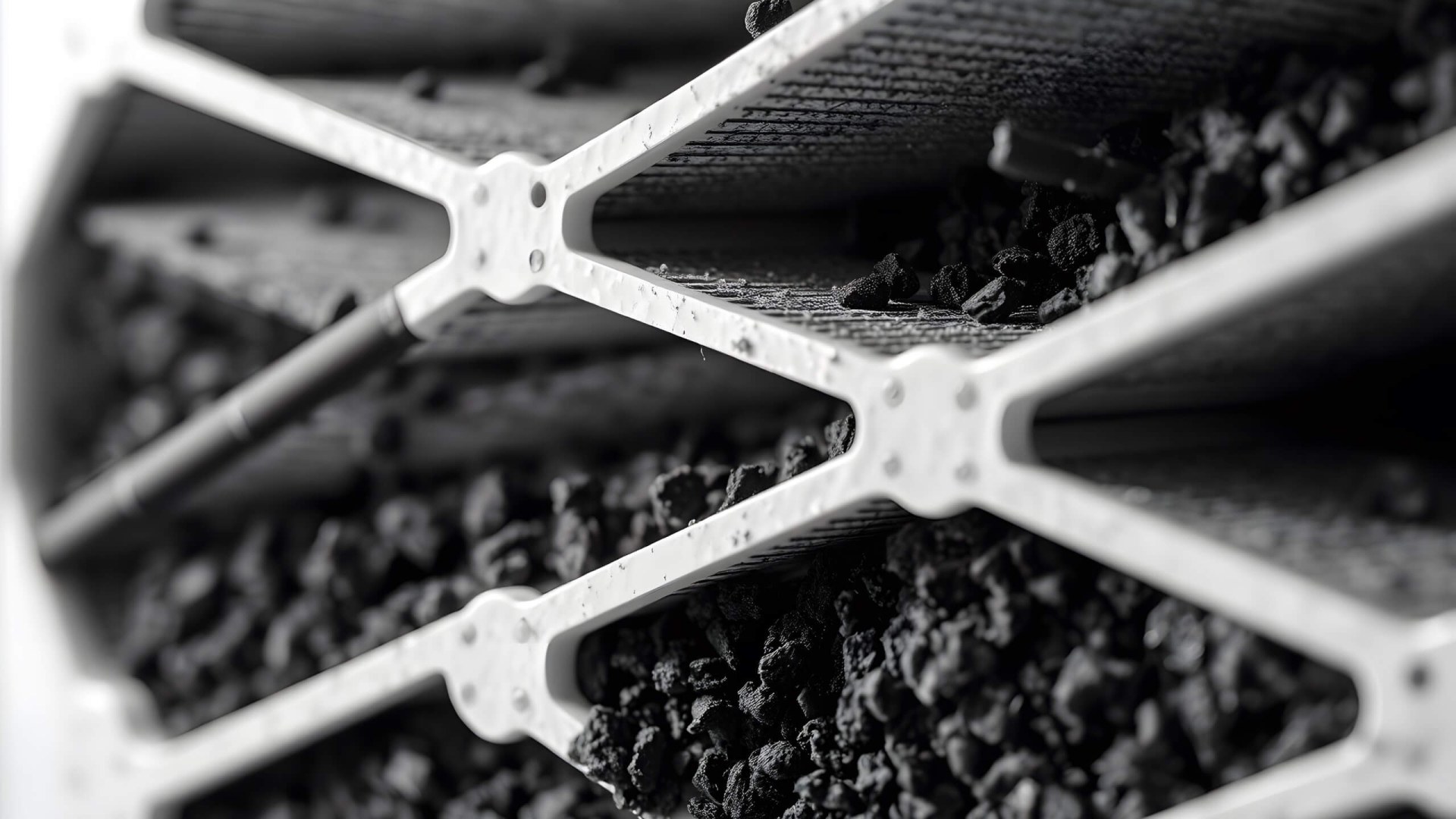
Special adsorbent materials known as molecular sieves are used for gas separation. Molecular sieves are materials with an extremely high specific surface area, capable of binding significant quantities of gas molecules on their surface through adsorption. A key characteristic of these materials is that they adsorb certain gases less strongly or more slowly than others. The molecular sieves applied are as follows:
In nitrogen generators: activated-carbon–based molecular sieves. These adsorb nitrogen more slowly than all other gas components present in air.
Carbon molecular sieves, supplied in small-granule form.
Gas Separation Process
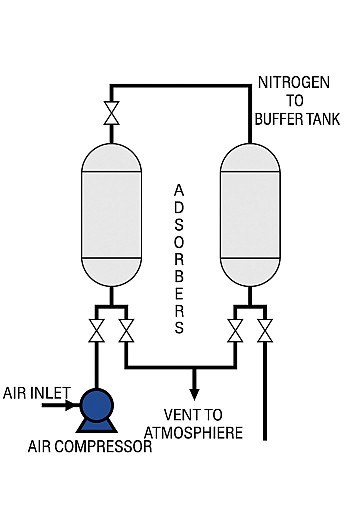
PSA Gas Generator Structure – Example of a Nitrogen Generator
Gas separation is carried out using the PSA (Pressure Swing Adsorption) method.
During the process, pressure is increased over the adsorbent material (the molecular sieve) by introducing compressed air. As pressure rises, more and more gas is adsorbed onto the surface of the adsorber. The gas that binds the weakest or slowest remains in the gas phase and becomes enriched until it can be removed in nearly pure form.
When the adsorber approaches saturation, the control system stops the process and vents the pressure to the atmosphere. As pressure drops, gas molecules previously bound at high pressure detach from the adsorbent and exit into the air. In this way, the molecular sieve regenerates itself automatically at low pressure.
In practice, a generator contains one pair of adsorbers (or in larger systems, multiple pairs operating in parallel). While one vessel produces gas, the other vessel is in the regeneration phase.